
Publisher: Seth Grossman,
453 Shore Road, Somers Point, NJ 08244 USA. Copyright © 2026 by SETH GROSSMAN
All Rights Reserved
No portion of this book may be reproduced in any form without the written permission of Seth Grossman or Liberty and Prosperity 1776, Inc. except as permitted by U.S. copyright law.
Library of Congress Control Number: 2026907123
Funding has been made possible in part by the New
Jersey Historical Commission, a division of Cultural
Affairs within the Department of State, through funds administered by the Atlantic County Office of Cultural and Heritage Affairs.
Introduction
Most of today’s schools and colleges use the basic narrative of “The 1619 Project” to teach American history. That “project” is a collection of teaching materials that has been published and distributed by The New York Times Magazine since 2019.
Its premise is that the traditional values, culture, and institutions of America were shaped by what happened in Jamestown, Virginia, in 1619. That was when black Africans were first sold there as slaves. It suggests that America needed a “fundamental transformation” during the past fifty years because it was built on slavery, conquest, and exploitation. That narrative is deceptive and inaccurate.
This book presents an honest and complete history. It describes how America was instead shaped by Quakers who created what is now known as South Jersey in 1676.
It begins with Native Americans migrating to South Jersey at the end of the Ice Age. It describes important events in the Middle East that brought Italian merchant sailors to the Atlantic Ocean, and then to America. It explains how “Wars of Religion” between Muslims and Christians, and then Catholics and Protestants, brought the English to Virginia and Massachusetts.
It then tells the remarkable story of George Fox. During the turmoil and violence of the English Civil Wars, this 23-year-old began preaching a new and radical Christian doctrine of peace, equality, and simplicity. Within a few years, he had more than 50,000 followers. They called themselves “The Religious Society of Friends.” Their detractors called them Quakers. They were often persecuted and jailed.
In 1674, those Quakers seized an opportunity to buy a half-interest in New Jersey, a failing British colony in North America. In 1676, they persuaded their co-owner to divide it into two separate colonies. The Quakers then owned and controlled most of what is now known as South Jersey. They wanted it to be more than a mere refuge. They wanted it to be a place where Quakers could put their vision for a better world into practice. There they could “show its strengths to the world.”
In 1676, those Quakers drafted and adopted a written charter that served as a constitution. It had an elected Assembly, secret ballots, and a comprehensive “Bill of Rights.”
They then created counties, towns, and townships with frugal governments that provided only the services they needed. They had few laws and officials, and almost no taxes. Yet people were free and safe, and their property was protected. Disputes were quickly and peacefully settled. Children were educated.
Most people in Quaker New Jersey soon produced far more than they needed. Their governments let them keep and enjoy almost all of it.
This made South Jersey a “poor man’s paradise.” Most settlers arrived as indentured servants with nothing but debt. Yet within ten years, most were comfortable, if not wealthy.
Quakers were taught and expected to live by the “Golden Rule.” They were to equally offer all others the rights and opportunities they enjoyed. There were no wars with Native Americans in South Jersey. There was no “Trail of Tears.” Women and Blacks could vote there in 1776. A handful of Quakers shamed most slave owners in South Jersey into freeing their slaves before American independence.
Five years after 1676, William Penn established a second “Quaker Commonwealth” in Pennsylvania. Both Quaker colonies became lands of “Liberty and Prosperity” long before those words became the motto of New Jersey.
During the 1730s, there was a revival of Christian faith throughout British
North America. Preachers from many denominations traveled in all thirteen colonies. They inspired and energized large crowds wherever they went. They made Christian faith and Bible values part of day-to-day American life.
This revival became known as “The Great Awakening.” It connected Quaker South Jersey and Philadelphia with the other British colonies in many ways. It made them all part of one new American nation of “Liberty and Prosperity.” to teach this to the next generation.
This book invites every school and college in America use a “1676 Project” to teach this to future generations.
SETH GROSSMAN , Atlantic City, New Jersey 2026
Chapter 14. The Pilgrims starve when “ the community” owns all land. They feast and give thanks when each family farms its own parcel.
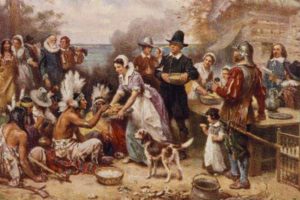
Above Image: “The First Thanksgiving” (1912). Painting by Jean Leon Gerome Ferris. Public Domain.
Storms took the Mayflower to land that was far north of Jamestown. However, after exploring the area, its passengers agreed to settle there. They named
the area “Plymouth.” Since their contract with the Virginia Company no longer applied, they made a written agreement to run the settlement themselves. It became known as The Mayflower Compact. Those settlers are now known as The Pilgrims.
The Pilgrims found many fields nearby that were already cleared and ready for planting. A Native American named Squanto later approached them. He explained that those fields had belonged to members of his tribe. He said they all had died from a plague a few years before. Squanto befriended the Pilgrims and taught them how to grow native crops like corn, beans, and squash.
However, the Pilgrims failed to grow enough food. Many died of hunger during the first two years. As in Jamestown, there was no private ownership of land.
All harvested crops were put into a common storehouse and distributed according to the needs of each family.
During the third year, the Pilgrims divided the land and gave each family its own plot. As in Jamestown, everyone worked much longer and harder for themselves and their families than they did for the community. The Pilgrims then had “bounteous” harvests and gave thanks. They quickly became prosperous and self-sufficient.
William Bradford, their Governor, explained this in his journal.
“No supply (ship) was heard of, neither knew they when they might expecte any. So they begane to thinke how they might raise as much corne as they could, and obtaine a beter crope then they had done, that they might not still thus languish in miserie. At length, after much debate of things, the Governor (with the advise of the cheefest amongest them) gave way that they should set corne every man for his owne perticuler, and in that regard trust to them selves; in all other things to goe on in the generall way as before. And so assigned to every family a parcell of land, according to the proportion of their number for that end, only for present use (but made no devission for inheritance), and ranged all boys & youth under some familie.
“This had very good success; for it made all hands very industrious, so as much more corne was planted then other wise would have bene by any means the Governor or any other could use, and saved him a great deall of trouble, and gave farr better contente. The women now wente willingly into the feild, and tooke their litle-ons with them to set corne, which before would aledg weaknes, and inabilitie;
whom to have compelled would have bene thought great tiranie and oppression.
Bradford then reflected on this “experience.” He wrote that it exposed the “vanity” and “conceit” of “godly and sober men” and “ancient” philosophers who advocated community control and ownership of what Communists today call the “means of production.”
“(They claimed) that the taking away of propertie, and bringing in comunitie into a comone wealth, would make them happy and florishing; as if they were wiser then God.
“For this comunitie (so farr as it was) was found to breed much confusion & discontent, and retard much imployment that would have been to their benefite and comforte. For the yong-men that were most able and fitte for labour & service did repine (express discontent) that they should spend their time & streingth to worke for other mens wives and children, with out any recompence. The strong, or man of parts, had no more in devission of victails & cloaths, then he that was weake and not able to doe a quarter the other could; this was thought injuestice.
The aged and graver men to be ranked and equalised in labours, and victails, cloaths, &c., with the meaner & yonger sorte, thought it some indignite & disrespect unto them. And for mens wives to be commanded to doe servise for other men, as dresing their meate, washing their cloaths, &c., they deemd it a kind of slaverie, neither could many husbands well brooke it. Upon the poynte all being to have alike, and all to doe alike, they thought them selves in the like condition, and one as good as another; and so, if it did not cut of those relations that God hath set amongest men, yet it did at least much diminish and take of the mutuall respects that should be preserved amongst them. And would have bene worse if they had been men of another condition. Let none objecte this is men›s corruption, and nothing to the course it selfe. I answer, seeing all men have this corruption in them, God in his wisdome saw another course fiter for them. . . “
This “experience” of the Pilgrims dominated the culture, economy, and politics of America for the next 350 years.
Soon afterwards, English “Puritans” obtained a charter from King Charles to establish a new “Massachusetts Bay Colony” north of Plymouth. They quickly established Salem, Boston and other large settlements and towns there.
Those Puritans were much like the “separatist” Pilgrims of Plymouth. They had similar beliefs and worshipped in the same way.
However, the Puritans wanted to control and “purify” the Church of England rather than separate from it. While in America, they wanted their colonial government to impose their “correct” Protestant beliefs on everyone living there. Besides Catholics, they also persecuted Quakers, Baptists, Anglicans and other Protestants who openly disagreed with them. . .
Chapter 17. George Fox starts the “Quaker” Movement in England. Thousands of his followers are persecuted and arrested.
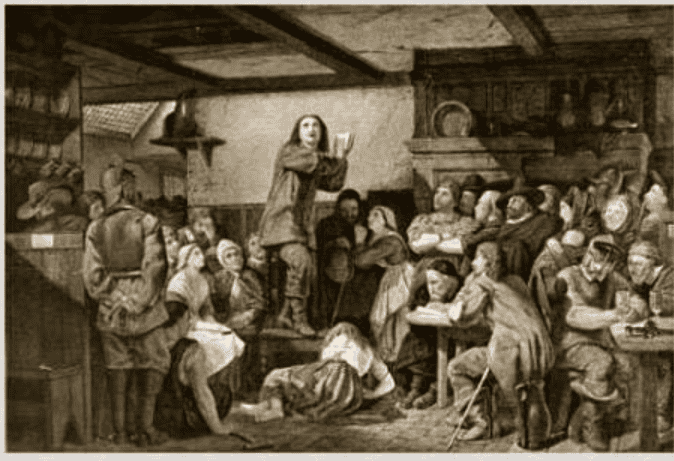
Above Image: George Fox Preaching in an English Tavern in 1650.
George Fox was a charismatic and revolutionary Christian leader in England. He attracted a large following during its civil wars. Fox began preaching in 1647 when he was 23 years old. He began as a Protestant “Dissenter.” He agreed with Martin Luther that every Christian can learn God’s truths by reading the Bible. He did not believe that Christians needed a professional, ordained clergy to instruct them.
However, Fox went further. He taught that besides the Bible, each of the “faithful” also has an “inner light” to “illuminate man’s sinfulness and lead in the way of truth and righteousness.”
Fox and his followers called themselves “Children of the Light”, “Friends of the Truth,” the “Religious Society of Friends,” or simply “Friends.” At first, only their detractors called the “Quakers”…
By 1660, there were roughly 50,000 Quakers in England. In 1685, roughly 1,300 of them were in English prisons. George Fox was jailed eight times. Many Quakers fled to Massachusetts, Jamaica, Barbados and other English colonies in America. Others fled to Holland or Dutch settlements in New Netherland (now New York, New Jersey, Pennsylvania and Delaware). However, many were also persecuted there.
Chapter 19.Quakers buy half of New Jersey.

In 1671, George Fox, then 47 years old, travelled to America. He first sailed to the Caribbean island of Barbados. He spoke out against the mistreatment of African slaves he met there. He urged Quakers to invite slaves to their meeting house and worship together with them.
Fox then sailed to Maryland and visited Quakers there. He also met and preached to Protestants of all denominations, Catholics, and even Native Americans.
In May of 1672, Fox visited Quakers in New York and Long Island. He took part in their “Half-Year’s Meeting” at Oyster Bay.
Fox thoroughly explored New Jersey along the way. He and other Quaker leaders rode on horseback from Maryland to New Castle, Delaware. From there,
they and their horses took a small sailboat across the river to New Jersey. Fox and his party then made “a tedious journey” through “bogs, rivers, creeks, and
wild woods” to Middletown. That was a new Quaker settlement on Sandy Hook Bay near Staten Island.
Fox observed that southern New Jersey was “not then inhabited by English so that we have travelled a whole day together, without seeing man or woman, house or dwelling place.”
A Quaker from Middletown then took Fox and his party to the meeting at Oyster Bay on his sailboat.
On their way back to Maryland, Fox and his party traveled through different parts of New Jersey. They “hired Indians to help with their canoes.” They “passed through many Indian towns, rivers, and bogs.”
When Fox returned to England in 1673, he stayed at the home of William Penn and his wife, Gulielma, near London. There, he talked to them and other Quaker leaders about what he saw in New Jersey.
“They began to realise that this tract of land could become the Quaker homeland of their dreams. There they could put their vision freely into practice and show its strength to the world. Penn’s connections could make this possible”.[1]
In 1675, Fenwick led several hundred Quakers to New Jersey. They built a new settlement by the Delaware River. They named it “Salem,” the Biblical English
translation of the Hebrew word for peace.
William Penn, and the other three Quaker trustees stayed in London to work with George Carteret. He still owned most of the other half of New Jersey. In July of 1676, the five of them agreed to divide and control it as two separate colonies. They wrote their agreement into the “Quintipartite” (Five Party) Deed.
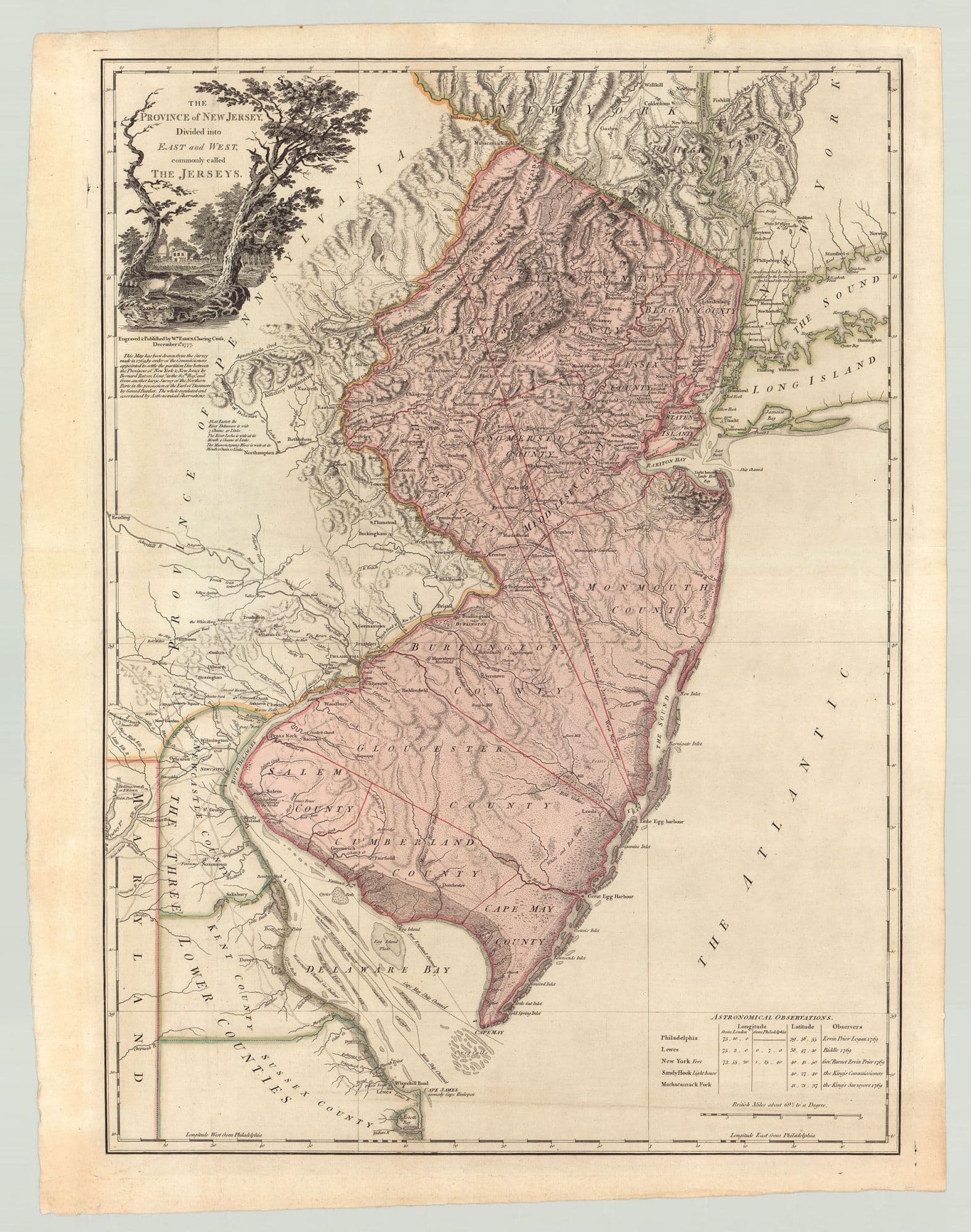
The “Quintipartite Deed” of 1676 created a straight boundary line that ran from Little Egg Harbor in the south to a point by the Delaware Water Gap in the north. Carteret was to own all unsold land east of that line as “East New Jersey.” Byllynge, Fenwick and the other Quakers would own everything west of that line as “West New Jersey.”
The terms “East New Jersey” and “West New Jersey” are confusing today. That is because most of what began as “East New Jersey” is now known as “North Jersey.” Most of what began as “West New Jersey” is now known as “South Jersey.”
Chapter 20. Quakers settle in Salem and Burlington. William Penn gives “West New Jersey” a constitution.
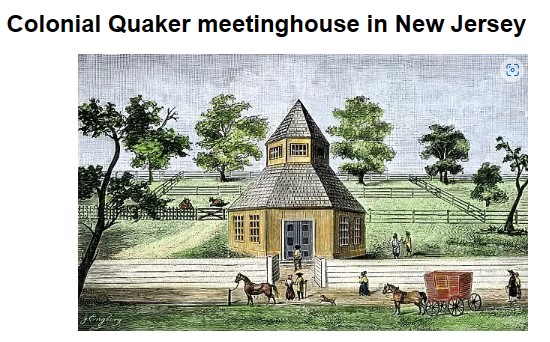
Above Image: “Burlington Meeting House, 1687-1786”. Illustration by J. Collins in 1900 “from an old painting.” Published in Smithsonian Magazine in 2017. Public Domain.
After agreeing with George Carteret to divide New Jersey, William Penn and Edward Byllynge worked to create a government for their West New Jersey. This was a complicated and uncertain process.
They first had to draft a new “Concession and Agreement” to govern their colony. They then had to get it approved by James, the Duke of York.
The original 1664 “Concessions” gave Berkeley and Carteret the right to rule
New Jersey. While they were free to sell their land as they pleased, they had no authority to sell their right to run the government there.
Moreover, some British officials claimed that the brief Dutch conquest and occupation of New Jersey, and the treaty that returned it, wiped out all rights of Berkeley and Carteret. According to them, New Jersey was again under the complete control of James, Dukeof York, as part of New York or “New England.”
Penn, Byllynge and the other Quakers ignored those claims. They quickly drafted new “Concessions” to establish their own separate colonial government in West New Jersey. They then lobbied James to approve it.
Penn and Byllynge consulted with some of the most respected political thinkers in England. They included Algernon Sidney and John Locke.
John Locke claimed that each individual is born with certain “natural rights,” and that “governments are instituted” to “secure” them. Locke said
that societies are built on a “social Wikimedia Commons. Public Domain. contract” with which people create governments that “derive their just powers from the consent of the governed.”
Algernon Sidney added that the “just powers” of governments must be very limited. That is because their only purpose is to protect the freedom, safety, and property of each citizen.
The writings of John Locke and Algernon Sidney were later widely published throughout England and its colonies. America’s Founders often referred to them when writing our Declaration of Independence and Constitution.
Penn and Byllynge were greatly influenced by Locke and Sidney. However, they were also influenced by the real-world experiences of Quakers living under colonial charters in Virginia, Massachusetts, Connecticut, and Maryland.
The new Concessions included much of what was written in 1664 Concessions by Berkeley and Carteret. However, they added other rights and details, including these:
- No taxes can be imposed without the consent of an elected “Assembly”.
- “No person or persons… shall be. . . punished or hurt . . . for the sake of his opinion, judgment, faith or worship towards God. . .”
- “No proprietor, freeholder or inhabitant of the said province of West New-Jersey, shall be deprived or condemned of life, limb, liberty, estate, property, or any ways hurt in his or their privileges, freedoms or franchises, upon any account whatsoever, without a due trial.”
- All civil and criminal trials shall be determined by 12-member juries. If an “Indian” (Native American) is a party to a case, six of the twelve jurors must be “Indians.”
- Voting in all elections must be by secret ballots placed in a sealed ballot box.
- Ten “commissioners” elected each year will survey and divide the land. They will decide how specific parcels of land will be sold or distributed to the proprietors.
- No land claimed by “Indians” can be sold unless they agree and are paid a fair price.
In May of 1677, 230 Quakers bought land and built a seccnd new settlement farther up the Delaware River. They named it “Burlington.”
Many Native Americans lived there. Some sold their land to the Quakers and moved elsewhere. Their agreements and deeds were put in writing.
Many show that the Native Americans knew the value of the land they sold and the goods they bought. In a typical deed, one Native American was paid
the following goods for a section of woods he sold in Burlington in 1677:
“30 matchcoats, 20 guns, 30 kettles and one great one, 30 pair of hose, 20 fathom (120 feet) of duffelds (coarse wool fabric), 30 petticoats, 30 narrow hoes, 30 bars of lead, 15 small barrels of powder, 70 knives, 30 Indian axes, 70 combs, 60 pair of tobacco tongs, 60 scissars (sic), 60 tinshaw looking glasses (eyeglasses), 120 awl blades, 120 fish hooks, 2 grasps of red paint, 120 needles, 60 tobacco boxes, 120 pipes, 200 bells, 100 Jewsharps, and 6 anchors (60 gallons) of rum.”[2]
While this was going on, Penn, Byllynge, and other “Friends” stayed in London. There, they mastered the art of court intrigue and British politics. They won over many key officials and skillfully played powerful factions and personalities against each other. On August 6, 1680, James finally signed papers recognizing Quaker political control of West New Jersey. The new Concession and Agreement then took effect. In 1681, elections were held, and the first Assembly met in Burlington.
Chapter 35. After thirty years, a few Quakers demand freedom for black slaves.

John Hepburn was a prosperous farmer who lived near Amboy in North Jersey. He came from Scotland in 1683 as an indentured servant working as a tailor.
In 1714, he published a 106-page book claiming it was “unlawful” for Christians to hold Blacks as slaves. Its full title was The American Defence of the Christian Golden Rule: An Essay to Prove the Unlawfulness of Making Slaves of Men.
Hepburn argued in detail that buying, selling, or owning Blacks as slaves violated the Golden Rule and each of the Ten Commandments. Hepburn refuted every argument he had heard to defend slavery. He called slavery a “vile contradiction of the Gospel of the Blessed Messiah.” He warned of God’s severe and unforgiving punishment of anyone who supported the enslavement of others in any way. That included buying sugar produced by slaves.
John Hepburn also begged for his own forgiveness for not acting sooner.
“I have lain dormant above this last thirty years for which I acknowledge my failure before God and Man. I desire the forgiveness of God, and next I desire the forgiveness of man. For the reason I was silent so long because I waited for my betters undertake the work. . .”
Front Page of Book Published by John Hepburn in 1715: “The American Defence of the Christian Golden Rule: An Essay to Prove the Unlawfulness of Making Slaves of Men.”
Benjamin Lay was an English Quaker who had been a sailor. He moved to Philadelphia in 1732 when he was 50 years old. He immediately denounced the enslavement of Blacks there. He personally confronted and criticized Quakers who owned or traded in slaves. He attended as many Quaker meetings as he could to speak against them…
“Portrait of Benjamin Lay” (1750) by William Williams. Wikipedia. Public Domain.
Chapter 36. A tailor from Mt. Holly shames Quakers into freeing their slaves.

During that time, a quiet young tailor from Burlington County, New Jersey, emerged. He succeeded where Hepburn and Lay had failed.
His name was John Woolman. During the next thirty years, he gently shamed Quakers in Pennsylvania and New Jersey into freeing their slaves.
Woolman was born in 1720 and raised as a Quaker. He worked on his father’s farm in Rancocas, Burlington County, until he was 21. He then worked for a merchant in nearby Mount Holly.
When he was 23 years old, Woolman’s employer asked him to prepare a bill of sale for a black slave woman he wanted to sell. This changed Woolman’s life. Woolman later recalled,
“He was an elderly man, a member of our Society, and I wrote it. But after executing it, I was so afflicted in my mind, that I said before my master and the Friend that I believed slave-keeping to be inconsistent with the Christian religion.”
From that moment on, Woolman worked tirelessly to end the owning and trading of slaves in England and America.
Woolman learned how to be a tailor.
He constantly traveled between New Jersey and North Carolina, selling and fitting clothing. He attended and spoke at Quaker meetings wherever he went. He attended and spoke at churches where there were no Quaker meeting houses nearby. Woolman reached out to everyone he met in taverns, inns, and stagecoaches. Unlike Benjamin
Lay, John Woolman was always gentle, patient, and respectful. He used relatable examples and parables. He was often described as “Christ-like.”
Woolman used almost every business, religious, and everyday conversation as an opportunity to persuade whoever he spoke to that slavery was an evil to be abolished. He urged every slaveowner he met to free his or her slaves at the earliest possible opportunity. He refused to draft wills for slaveowners unless they included a provision to free their slaves. He urged Quaker meetings and other church groups to adopt resolutions condemning slavery.
Woolman made Biblical arguments to those who relied on the Bible. He appealed to reason when speaking with those familiar with Enlightenment philosophers like John Locke.
Woolman said this when talking to an unnamed “thoughtful man”, a “colonel in the militia” he met in Virginia.
“Men, having power, too often misapplied it. Although we made slaves of negroes, Turks made slaves of Christians. However, liberty is the right of all men equally.”
After several years, John Woolman quit his business of selling and tailoring clothing. He became what Quakers call a “minister” or “elder.” He spent all of his time teaching, writing, traveling, and speaking against slavery throughout America…
In 1758, the Yearly Meeting for Quakers in Pennsylvania and the southern part of New Jersey recommended “without spoken dissent” that all Friends
“set free those they hold in bondage.” This was the same organization that expelled and “disowned” Benjamin Lay for demanding the same thing twenty
years before.
That meeting also appointed John Woolman, Daniel Stanton, John Churchman, and other “ministers” and “elders” to a special committee. Their mission
was to approach all slaveholding Quakers they encountered as they traveled. They were to remind them of their “Christian obligation” to free their “enslaved men, women, and children.”
In 1772, John Woolman traveled to England. He urged Quakers there to help him end slavery throughout the British Empire. However, he soon became sick from smallpox and died there.
John Woolman kept a journal of his thoughts and experiences during his life. It was published shortly after his death as The Journal of John Woolman. It has been continuously published and sold ever since. It was recognized by John Stuart Mill and Charles Lamb as a great work of English literature and philosophy. It is in Volume 1 of the Harvard Classics collection.
In 1774, Quakers in Pennsylvania called for the “disownment” or shunning of Quakers who owned slaves. In 1775, they formed a Society for the Abolition of Slavery.
Chapter 38. New Jersey government is “extremely small, limited in its powers, and cheap.”
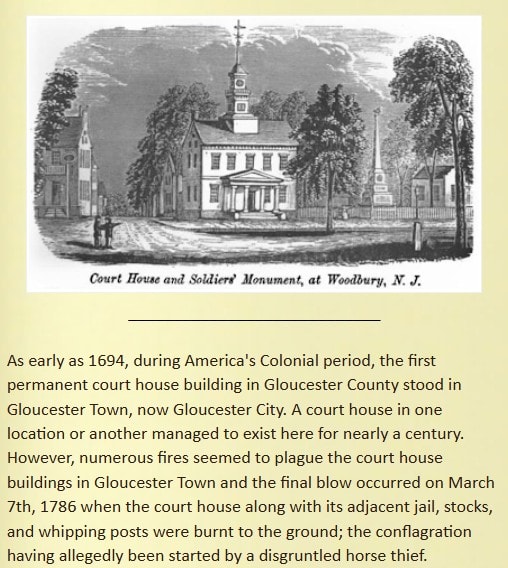
In colonial New Jersey, the entire county government was often housed in two public buildings. One was a courthouse which also had offices for the clerk, surrogate, coroner, and tax assessor. The second was a nearby jailhouse where
the sheriff had his office.
British Historian Paul Johnson wrote this description of New Jersey and the other British colonies in North America during the 1700s:
“They were the least taxed territories on earth. Indeed, it is probably true to say that colonial America was the least taxed country in recorded history.
“Government was extremely small, limited in its powers, and cheap. Often, it could be paid from court fines, revenue from loan offices, or sale of lands. New Jersey and Pennsylvania governments collected no statutory taxes at all for several decades.
New Jersey had 13 Counties in 1822. Gloucester County with its Courthouse in Woodbury then included what are now Atlantic and Camden counties. Source:
“Geographical, Statistical and Historical Map of New Jersey” from 1822 edition of Carey & Lea’s Complete Historical, Chronological, and Geographical American Atlas, Philadelphia, Pennsylvania
“One reason why American living standards were so high was that people could dispose of virtually all their income. . . It was the closest the world has ever come to a no-tax society. . .”[3]
In 1692, the only tax imposed by the Assembly was a yearly head tax of 2 shillings and 6 pence for every person more than 16 years old. That would be
roughly $31.40 per year today.
In 1693, the Assembly replaced the head tax with a property tax. The tax was one penny per year for one acre of improved land, 6 shillings for 100 acres of unimproved land, 6 pennies per year for each head of cattle or sheep and 12 pennies per year for a horse. In 1697, that tax rate was cut in half.
County governments also imposed taxes. In 1702, West New Jersey had four counties. They were Burlington, Gloucester, Salem and Cape May. Most of them had only a handful of paid officials. They usually included several judges and a Clerk, Sheriff, Surrogate, Coroner, and Tax Assessor.
Judges presided over civil and criminal cases. West New Jersey also had a unique informal court for small claims. This allowed litigants to quickly and inexpensively resolve small disputes without lawyers.
The Clerk kept and maintained a public record of every deed. This prevented disputes over land ownership.
The Sheriff enforced laws and judgments. He had the power to summon citizens to serve on juries. In unusual circumstances, he could summon men to bring arms and help him enforce the law. That power was called the “posse comitatus” or power of the community.
The Surrogate protected the rights of widows, orphans and others entitled to the property of those who died.
Most counties had a Coroner to investigate suspicious deaths. They also had a Tax Assessor to determine the value of real estate and farm animals that were taxed.
These county officials were usually paid with fees they collected from people who used their services.
Only landowners who lived in the county could vote. People who owned land were known as “freeholders.” Each year they elected a “Board of Chosen Freeholders” for their county.
These Chosen Freeholders met from time to time to decide what roads, bridges, jails, and courthouses had to be built, maintained or repaired. They also decided how much money was needed to pay for them. That money was paid with a tax on real estate and farm animals.
NOTE: In 2020, the New Jersey Legislature and Governor Phil Murphy enacted a new state law saying that counties could no longer give those county officials the title of “Freeholder.” Their title must now be “Commissioner”. Lieutenant Governor Sheila Oliver said this was done because “People know the term is offensive and refers to a time when only white male landowners could hold public office.”
(This is not true! Between 1776 and 1807, when voting laws were changed, all “inhabitants” of New Jersey “of full age” could and did vote and hold office if they were “worth 50 Pounds of Proclamation Money.” This included Blacks and women.)
The Assembly divided most counties into smaller townships. Each township elected a “township committee” to build and maintain roads and bridges and provide other services not provided by the county. Township committees imposed additional taxes on real estate, buildings, and farm animals to pay for this.
Township committees also appointed constables to help county judges and the sheriff enforce the laws. Constables apparently received little . or no pay. Court records show that appointed constables often requested to be “excused” from their appointments. Some were held in contempt and punished for not accepting them. Some avoided constable duty by paying substitutes.
In 1693, the colonial government of West Jersey created Egg Harbor Township in Gloucester County. At first Egg Harbor Township included all of what is now Atlantic County. In 1774, it was split in half. The northern part became Galloway Township. At that time, it included what are now Hammonton, Mullica Township, Egg Harbor City, Port Republic, Brigantine, and Absecon.
Colonial voters, legislators, and county and township officials were usually thrifty. Only landowners paid real estate taxes. Only landowners who paid those taxes voted and held public office.
In 1703, Britain merged East and West New Jersey into one colony of New Jersey. However, the unified colony continued to have two capitals. The Assembly met in Perth Amboy for some sessions and in Burlington for others.
The Governor resided in one town or the other.
Chapter 39. Few children go to public schools, but most learn “the three R’s.”
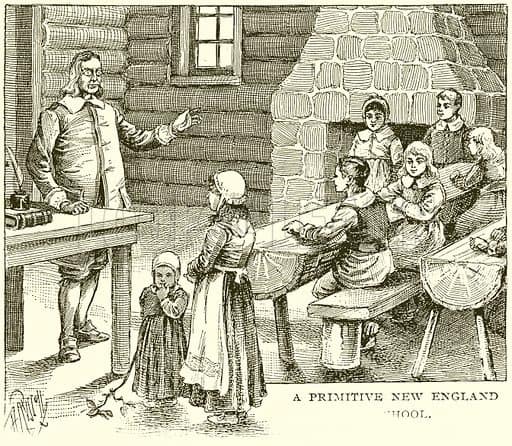
Above Image: Drawing of a “Primitive New England School” during the early 1700s. Most schools in South Jersey were similar.
Properly educating children was very important to almost all Quakers and other Protestants in South Jersey.
They wanted their children to “fear the Lord” and do “His will on earth.” Their children had to read and understand the Bible to do that. They also wanted
their children to learn how to support themselves with honest, productive work and to manage their households.
These had been core beliefs of Protestants ever since Martin Luther publicly posted his 95 Theses in 1517. Martin Luther also translated the Bible from Hebrew, Greek and Latin into German in 1522 so everyone could read it. William Tyndale did it for English in 1525.
Each Christian parent, therefore, had a personal responsibility to teach reading, writing, and arithmetic (reckoning) to their children. Every Christian also had an obligation to make sure that orphans and children with parents too poor to do so were educated.
“Primitive New England School” Unknown Artist. Public Domain. This is what the first schools in West New Jersey also looked like.
In some South Jersey towns, boys were also expected to learn the basics of navigation at sea and of measuring and surveying land.
Well-off families hired tutors for their children. Others pooled their resources to hire teachers for the children of several families who lived near each other.
During this time, boys often became apprentices to learn skills from professionals, tradesmen, mechanics, or craftsmen. Masters of those skills were often required by law to also teach their apprentices what were later called “the three R’s” (Reading, ‘Riting and ‘Rithmetic/ Reckoning)…
It appears that most children in South Jersey got a basic education and that most adults were literate. In 1690, Michael Buffin asked the court in Burlington County to excuse him from being appointed constable because “he can neither read nor write”. This indicates that literacy was an important qualification for even a minor position. It also shows that being illiterate was not common. The records of that court from 1680 to 1709 do not show any other instance of a constable being excused for that reason.
Although most children received a minimal, basic education from schooling, many later taught themselves more advanced subjects and skills.
Benjamin Franklin is a famous example. Although he grew up in Boston, Massachusetts, he was typical of many men and women in all of the colonies of British North America.
Franklin was the tenth of 17 children in his family. He had had two years of schooling that ended when he was ten years old. However, Franklin was an avid reader of books that he later bought, borrowed or shared. He formed groups and exchanged letters to discuss what he read. By doing this, Benjamin Franklin taught himself to become one of the most respected scientists, journalists, and political leaders in the world. Many other men and women in South Jersey and the rest of America did the same…
Chapter 40.Success and “the Golden Rule” make Quakers a minority in their own “homeland.”
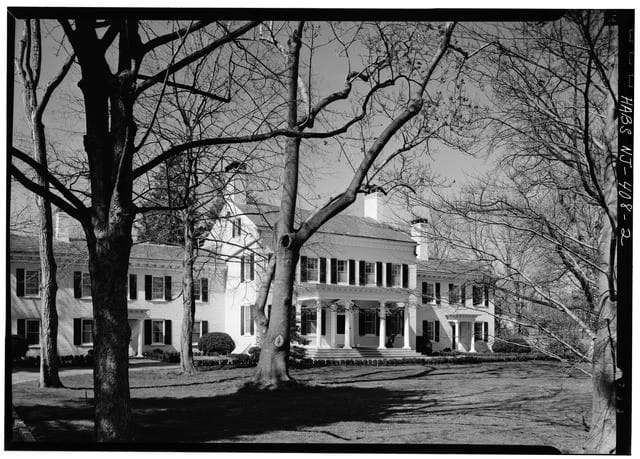
Above Image: “Morven”. The grandfather of Richard Stockton, a signer of the Declaration of Independence built this home as his residence in 1709. (This 1964 photo shows two additions that were built later.) Photo by Jack Boucher. Source: Library of Congress. Public Domain.
Many Quakers came to South Jersey and Pennsylvania because they were persecuted elsewhere.
Beginning in 1656, the Massachusetts Bay Colony* enacted a series of laws banning Quakers. Many Quakers defied that ban and were arrested. In 1658, Massachusetts Bay enacted a new law imposing the death penalty for any Quaker who openly preached in the colony after being expelled. Between 1659 and 1660, Massachusetts Bay executed four Quakers. One of them was Mary Dyer.
*The Massachusetts Bay Colony was founded by Puritans in 1630. It was separate from the Plymouth Colony, run by “Separatists” known as the Pilgrims until 1691.
The Dutch also persecuted Quakers in Long Island when it was part of New
Netherland. That persecution continued for years after Britain seized the colony in 1664.
“The Quaker Mary Dyer
Led to Execution on Boston Common, June 1, 1660”. (Around 1660, Unknown Artist, Brooklyn Museum. Source: Wikimedia Commons. Public Domain.
However, Quakers enjoyed spectacular success in South Jersey and Philadelphia, where they enjoyed equal rights.
“Philadelphia had been founded and shaped by Quakers. But the Quakers themselves had become rich. A tax-list of 1769 shows that they were only one in seven of the town’s inhabitants, but that they made up half of those who paid over 100 British Pounds in taxes. Of the town’s seventeen richest men, twelve were Quakers.
“Wherever the hard-working, intelligent Quakers went, they bred material prosperity which raised up others as well as themselves.”[4]
By 1775, Philadelphia had roughly 40,000 people and was by far the largest city in British North America. At that time, the next largest cities were New
York with roughly 21,000 people, Boston with 17,000, and Charleston, South Carolina with 12,000.
However, this success also attracted many non-Quakers from all over Europe and other American colonies. Quaker tolerance and commitment to the “Golden Rule” gave all newcomers equal opportunities to succeed. By 1738, Quakers were a minority in both South Jersey and Philadelphia, their “Quaker Homeland.”
A 1738 census showed that only 6,800 of the 17,150 people in Burlington, Gloucester, and Salem counties were Quakers. There were only 50 Quakers among the 1,200 inhabitants of Cape May County. Quakers were only 37% of the population of South Jersey.
Chapter 41.Americans have a “Great Awakening” of Christian faith.
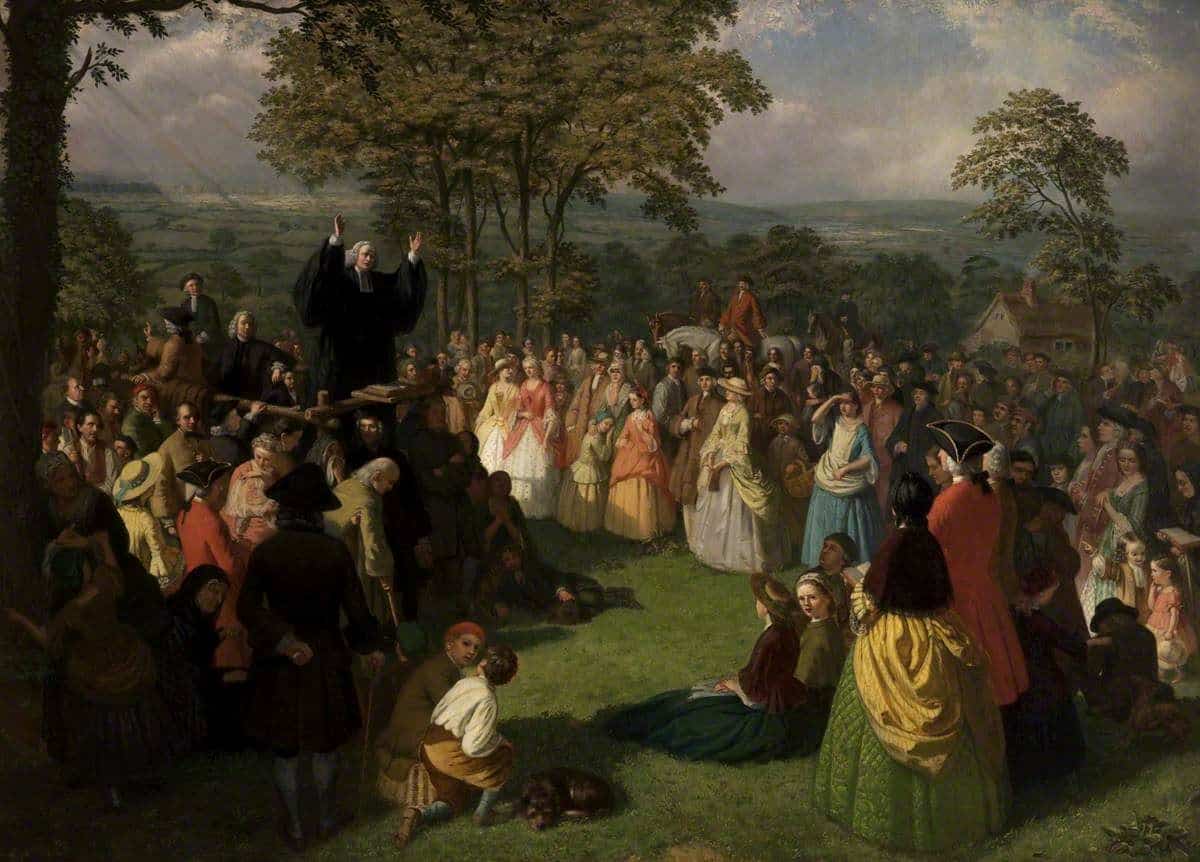
Above Image: George Whitefield, Bolton England in June of 1750.
During the 1720s, many religious leaders in Britain and its American colonies warned that a dangerous decline in Christian worship, faith, and behavior was taking place.
Joseph Belcher, a prominent Christian historian, later described their concerns in his book George Whitefield, a Biography, published in 1857.
“The distinguishing doctrines of Christianity—the atonement, the work and office of Christ and the Spirit were comparatively lost sight of. The vast majority of sermons were miserable moral essays, utterly devoid of anything calculated to awaken, convert, save or sanctify…
“The highest personages in the land then lived openly in ways contrary to the law of God, and no man rebuked them. Profligacy (wasteful extravagance/moral looseness) and irreligion were reputable and respectable. Judging from the description we have of men and manners in those days, a gentleman might have been defined as a creature who got drunk, gambled, swore, fought duels, and violated the Seventh Commandment (adultery), and for all this, very few thought the worse of him.
“Those too were the days when. . . (t)o be an infidel, to obtain power by intrigue, and to retain it by the grossest and most notorious bribery were considered no disqualification even for the highest offices. Such men indeed were not only tolerated, but praised.”[5]
Although there was widespread wealth and comfort in America, hardship, death, and tragedy were never far away. Between 5% to 10% of all married women died in childbirth. Nearly half of all American children died before their fifth birthday. There was a spiritual need for faith, comfort, and purpose.
William Tennent was one of the first to call for a Christian revival. He was a Presbyterian minister who had previously lived and preached in Scotland and Ireland. In 1726, he moved to Neshaminy in Bucks County, Pennsylvania. Starting in the 1730s, he and his four sons preached in a new way that was personal and heartfelt. They traveled from town to town throughout New Jersey and Pennsylvania. They welcomed worshippers from all denominations and often spoke at large outdoor gatherings.
Tennent and his sons spoke of their own sins and shortcomings. They told of how they had overcome them by coming to Christ and beginning their lives anew. They invited others to do the same and share their hope and joy.
In 1727, William Tennent began teaching his methods to young preachers in a log house in Neshaminy. It became known as the “Log College.” Its graduates travelled and preached throughout the British North American colonies.
George Whitefield grew up in Gloucester, England. He became an ordained minister of the Church of England in 1732, at age 18. However, he did not become a rector in a parish church. He instead traveled from town to town throughout England. He often preached to large outdoor crowds.
In 1738, George Whitefield sailed to Savannah, Georgia, to set up an orphanage. He then returned to America five more times during the next 30 years. Whitefield spoke at hundreds of small meetings and to many large outdoor crowds from Georgia to Massachusetts.
42. George Whitefield awakens Philadelphia and South Jersey.

In 1739, George Whitefield came to Philadelphia. He spoke from the balcony of the Old Courthouse at Second and Market Streets. Benjamin Franklin, a religious skeptic, went as a scientist to observe him and his audience.
Franklin carefully walked through and around the crowd. He carefully listened to what Whitefield was saying and how people responded to him. Franklin estimated that out of a much larger crowd, at least 25,000 to 30,000 people could clearly hear “every word.” At the end of the sermon, Franklin wrote that he and an equally skeptical friend were so impressed that they “emptied their pockets of all coins, including the gold” and put them “in Whitefield’s collection dish.”
Benjamin Franklin later published Whitefield’s sermons and delivered them throughout America.
Whitefield spoke to all Christians. He ridiculed the differences that often divided them. Once, when speaking in Philadelphia, Whitefield openly imagined having this conversation with the Old Testament Patriarch Abraham:
“Father Abraham, who have you in heaven? Episcopalians?” “No”. “Any Presbyterians?” “No.” “Any Baptists?” “No.” “Have you any Methodists, Seceders or Independents?” “No. No. No!”
“Why who have you there?” “We don’t know those names here. All who are here are Christians—Believers in Christ—Men who have overcome by the blood of the Lamb and the word of his Testimony?”
“Oh is that the case? Then God help me. God help us all to forget the party names and to become Christians in deed and truth!”
Whitefield even recalled attending services at a Jewish synagogue in Gibraltar. He said he went there when his ship from England stopped there on its way to Georgia. Whitefield said the rabbi invited him to sit at the “chief seat.” The rabbi said he had heard Whitefield preaching against “profane swearing” the day before and wanted to thank him.
During 1740 and again in 1746, George Whitefield spoke throughout South Jersey. He attracted and energized large crowds at outdoor meetings in Gloucester, Greenwich in Cohansey, Salem, Cape May, Cedar Bridge (Bargaintown), Burlington and Maidenhead (now Lawrence Township). He also preached to young Native American men at their settlement in Brotherton (now Indian Mills).
During those years, Jonathan Edwards a Puritan from Connecticut, Jonathan
Dickinson, a Presbyterian from Massachusetts, and the four sons of William
Tennent, also gave emotional, inspiring sermons to large outdoor crowds. Jonathan Edwards reached thousands more by publishing his sermons.
All of this made Bible values, Christian faith, and church attendance an important part of everyday American life again. This Christian revival became known as “The Great Awakening.”
The Great Awakening inspired the formation and expansion of many new congregations and the building of many new churches throughout South Jersey.
They included new Presbyterian churches in Pilesgrove (Pittsgrove), Deerfield,
Fairfield, Timber Creek (Blackwood) and Cold Spring, and the Forks of Little Egg Harbor (Pleasant Mills). They also included Baptist churches at Mill Hollow near Salem, Daretown, and Dividing Creek.
The Great Awakening encouraged congregations of different denominations to share buildings, chairs, and benches, and to attend each other’s events.
In 1761, Andrew Blackman donated land to build a new “Presbyterian Meeting House” on Zion Road in the area of Egg Harbor Township known as “Cedar Bridge” (Bargaintown). The deed specified that the building be available for “public religious worship for all that shall incline to meet and assemble in it.” Methodists began using it in 1789. Today it is the Zion Methodist Church. Enoch “Nucky” Johnson, who dominated Atlantic City politics from 1913 to 1941, is buried in its cemetery.
In 1746, Jonathan Dickinson co-founded the College of New Jersey together with graduates of the “Log College” of William Tennent. He also served as its first President. In 1754, George Whitefield gave the commencement address and received an honorary “Master of Arts” degree.
In 1758, Jonathan Edwards became its third President. The College of New Jersey later became Princeton University.
While Whitefield and the others were preaching in America, John Wesley was leading a similar evangelical movement in England. It was later called “Methodism.” In 1771, Wesley sent 26-year-old Francis Asbury to preach his doctrine and establish Methodist Churches throughout America. He did that for the next forty years.
Asbury established many new Methodist churches in the Quaker-settled counties of South Jersey including these:
Absecon Methodist Church in 1796, Head of the River Methodist Church in Estell Manor in 1792, Olivet Methodist Church in Centerton in 1773, the Friendship Methodist Church in Salem and Trinity Methodist Church in Pennsville in 1775, Port Elizabeth Methodist Church in 1778.
Asbury’s fierce opposition to slavery appealed to many Quakers. Asbury later suggested that America’s War for Independence was a just cause that good Christians could fight for. This appealed to many younger Quakers.
South Jersey (and rest of the world) timeline
1453: Muslim Ottoman Turks seize Christian Constantinople and control the Mediterranean Sea.
| 1492: | Christopher Columbus leaves Italy and crosses the Atlantic Ocean for Spain. He claims “The West Indies” for Spain. | |||
| 1498: | John Cabot (Giovanni Caboto) leaves Italy and crosses the Atlantic Ocean for England. He claims most of North America (including what is now New Jersey) for England. | |||
| 1517: | Martin Luther teaches Christians in Germany to be guided by the Bible instead of priests. | |||
| 1524: | Giovanni da Verrazano leaves Italy and crosses the Atlantic for France. | |||
| 1529: | Pope Leo X condemns Martin Luther as a “heretic.” Charles V of Spain goes to war against “Protestants” who “protest.” | |||
| 1534: | King Henry VIII takes the churches of England away from the Pope. However, he persecutes and executes Protestants who want a “Reformation”. | |||
| 1558: | Elizabeth I becomes Queen and makes England safe for Protestants. | |||
| 1560: | Spain and Italian states form a “Holy League” to fight the Ottoman Turks on land and sea. | |||
| 1588: | Spanish Armada fails to subdue England. | |||
| 1600s: | The Church of England persecutes “Separatists” and “Dissenters.” | |||
| 1607: | England “plants” settlers in Jamestown, Virginia. | |||
| 1614: | Dutch merchant and ship captain Cornelius Jacobson Mey visits and names Cape May and Egg Harbor. | |||
| 1619: | Dutch privateers sell 20 African slaves to English settlers in Jamestown, Virginia. | |||
| 1620: | England tolerates “Separatists” if they move to America. The “Pilgrims” settle in Massachusetts. | |||
| 1623: | The Pilgrims feast and give thanks when they end “community” ownership of land. | |||
| 1624: | The Dutch establish “New Netherland” along the Hudson River and on Long Island. | |||
| 1638: | Swedes and Finns settle in “New Sweden” by the Delaware River. | |||
1642 England is divided and weakened by civil wars. through 1651:
| 1647: | George Fox starts the Quaker movement in England. |
| 1655: | The Dutch seize New Sweden and settle along the Delaware River. |
| 1660: | Parliament unites England. Charles II becomes King, and his brother James, Duke of York, becomes “Lord Admiral” of the Royal Navy. |
| 1661: | King Charles II proclaims that Quaker meetings are “unlawful.” |
| 1664: | (February) Carteret and Berkeley sign “Concessions and Agreements” as a constitution for New Jersey while the Dutch still own it. |
| 1664: | (March) King Charles gives all of “New England” (which includes Dutch “New Netherland”) to his brother James, Duke of York. |
| 1664: | (May): Captain Richard Nicolls leaves England with four warships to capture New Netherlands. |
| 1664: | (June) James gives New Jersey to George Carteret and John Berkeley. |
| 1664: | (October) The Dutch surrender New Netherland to the British without a fight. |
| 1670: | There are roughly 50,000 Quakers in England. Some 1,300 are in prison. William Penn is arrested and put on trial for preaching to a crowd in the street. |
| 1672: | George Fox explores New Jersey |
| 1673: | George Fox and William Penn make plans for a “Quaker Homeland” in New Jersey. |
| 1674: | Quakers buy half of New Jersey from John Berkeley. |
| 1675: | John Fenwick establishes Salem as the first Quaker settlement in West Jersey. |
| 1676: | Quakers and George Carteret divide New Jersey into “East” and “West.” |
| 1676: | West Jersey Quakers adopt a new “Concessions and Agreements” written by William Penn and Edward Byllynge. |
| 1677: | Quakers settle in Burlington. |
| 1677: | Quakers bargain and pay for land claimed by Native Americans. |
| 1680: | James, Duke of York, recognizes and approves Quaker rights to govern West Jersey. | |
| 1681: | First elected West Jersey Assembly meets in Burlington. | |
| 1680s: | John Somers builds a “log house” by the “point” between the river and the Great Egg Harbor. | |
| 1680s: | Somers and his neighbors live prosperous, comfortable lives. | |
| 1685: | West New Jersey Assembly dedicates a 300-acre island in the Delaware River to fund public schools in Burlington. | |
| 1686: | Slaveowner in Burlington acquitted after trial for “occasioning” the death of a “Negro woman servant.” | |
| 1690: | Ten ships with African slaves from the Caribbean arrive in Philadelphia. | |
| 16921694: | West Jersey creates counties and county governments for Burlington, Cape May, Gloucester, and Salem. (Gloucester includes what are now Atlantic and Camden.) | |
| 1702: | East and West New Jersey again become one British colony of New Jersey. | |
| 1714: | John Hepburn publishes book denouncing slavery as “anti-Christian. | |
| 1715: | Bog iron is forged at Mount Holly. | |
| 1738: | Census confirms that Quakers are a minority in their West Jersey “homeland.” | |
| 1739: | George Whitefield brings the “Great Awakening” to Philadelphia and South Jersey | |
| 1743: | John Woolman of Mount Holly shames most Quakers into freeing their slaves. | |
| 1748: | Assembly creates Cumberland County out of Salem County. | |
| 1756: | Bands of Lenni Lenape attack and kill settlers near the Delaware Water Gap. | |
| 1758: | Lenni Lenape sign the “Treaty of Easton”. Most leave New Jersey for payment of $1,000 Spanish dollars and promise of land near Ohio River. | |
| 1758: | Quaker Yearly Meeting for Philadelphia and Burlington “recommends” that Quakers free their slaves. | |
1796: Gloucester County, New Jersey has 321 free Blacks and 29 slaves.
About the Author

Author Seth Grossman on the Atlantic City Boardwalk. (Photograph by Vernon Ogrodnek)
Seth Grossman is a lifelong resident of Atlantic City, New Jersey, with a passion for its local history. He is a graduate of Duke University and Temple Law School. He has been a practicing attorney in and around Atlantic City since Between 2010 and 2017, he was an adjunct professor of U.S. History at Atlantic Cape Community College. He has been the Executive Director of Liberty and Prosperity 1776, Inc. since its founding in 2003. He is a regular guest on several popular talk radio programs heard in and around South Jersey and Philadelphia.
Liberty and Prosperity 1776, Inc. was established as a tax-exempt educational charity in New Jersey in 2003. Its mission is to teach why “Liberty and Prosperity”, New Jersey’s motto since 1777, is true and relevant today and how Americans can again become free and effective citizens. Its website is LibertyAndProsperity.com