
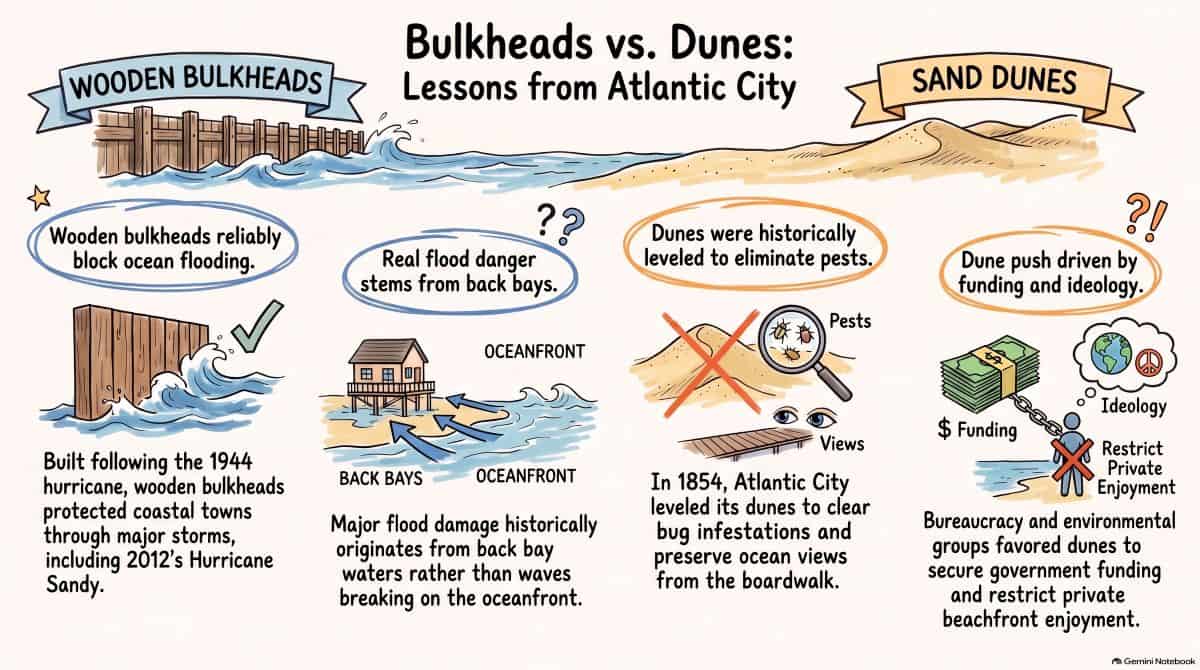
FROM SETH GROSSMAN INTERVIEW ON HARRY HURLEY RADIO PROGRAM:
WPG Talk Radio 95.5 FM and 1450AM near Atlantic City on September 30, 2026
Harry Hurley: All right, citizen Seth Grossman is here, because while everybody’s thinking that the flooding happens because of the ocean, there are those who believe it’s happening at the back bay. So that the bulkheads, not the dunes, are your more rightful protection, if you will.
Seth Grossman: People who say that sand dunes protected Atlantic City and Margate from more severe flooding during the storm last weekend remind me a story my Dad once told me when he was stationed in Atlantic City for a few weeks during the early days of World War II. One of his duties was to guard the boiler room of the St. Charles Hotel at New Jersey Avenue and the Boardwalk with a wooden rifle. My Dad told me that in 1942, the army did not have enough real rifles to go around, so they gave out wooden rifles!” I said, “What did they give you a wooden rifle? What good was it.” And then my Dad smiled and said, “it worked just fine! The Germans never came near the place!”
I think of my Dad’s wooden rifle when people tell me how we needed sand dunes to protect beach towns like Atlantic City and Margate from ocean flooding last weekend.
Let’s start by talking about how we those wooden bulkheads and concrete seawalls along the beach and Boardwalk from the Inlet in Atlantic City all the way down to Longport.
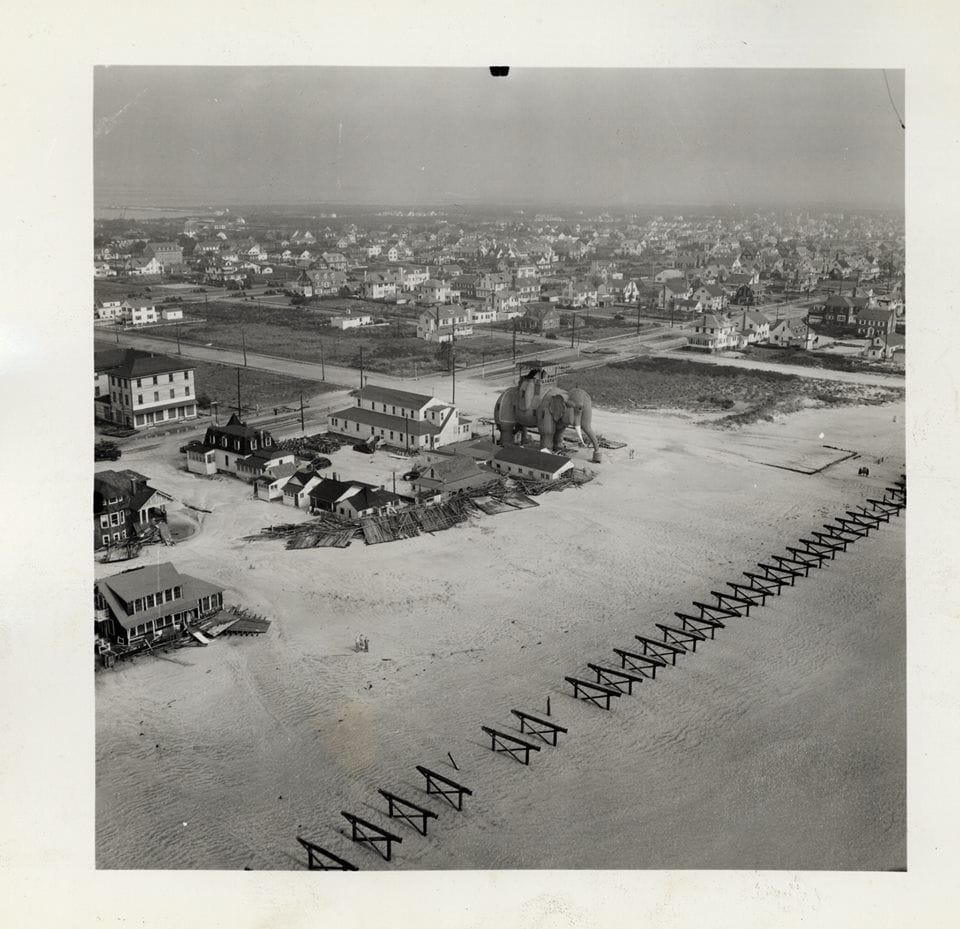
Above Image: Margate, NJ Beach and Elephant Shortly After 1944 Hurricane.
In 1944, we had a devastating hurricane in Atlantic City. It wiped out the old Heinz Pier, the Margate Boardwalk, and it did a lot of damage all over the island.
Harry Hurley: Yep.
Seth Grossman: And in response to that, Atlantic City—with no federal aid, and no state aid other than money from a new local luxury tax–built those wooden bulkheads and concrete seawalls all along the Boardwalk. And of course, it wasn’t just that Hurricane of 1944. Before that, the old-timers would talk about the northeaster of 1938, which knocked out the Brigantine Bridge. That is how a guy called Captain Starn made a fortune taking people back and forth from Brigantine. And that’s how he got the money to do a lot of his improvements at the Captain Starn’s Restaurant that a lot of us Boomers went to growing up.
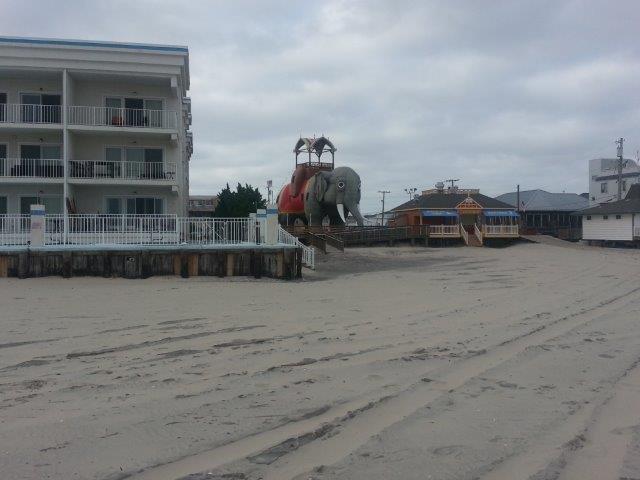
Above Image: Margate NJ Beach and Elephant Shortly After “Superstorm Sandy” in 2012. There were no sand dunes at the time and little, if any flooding from the ocean.
We grew up with those wooden bulkheads all along the ocean; they were normal. And in some street ends, you actually had concrete seawalls. That wooden bulkhead stopped basically the water from coming up from the ocean in 1962. Almost all the flooding came from the back bay.
And we went through this with Hurricane Sandy in 2012. When you look at the photographs, you’ll see right by the Margate elephant, that same wooden bulkhead that was built in Atlantic City by the Boardwalk was also built through Ventnor, Margate, and Longport. And that bulkhead, during Hurricane Sandy 2012, stopped the flooding.
Host: We went away from what worked, and we put something in that doesn’t work.
Seth Grossman: Yes. And you don’t have to be an expert in engineering to watch how waves break on the beach during ocean storms. When you had a wide, flat beach, you would see that the waves would break 50 yards away from where the bulkhead was, and just the water would come up, and the bulkhead would stop the water. If you look at the photographs of the Margate elephant, you’ll see that the wooden bulkheads stopped the water, and the only flooding that took place during Sandy down in this area was from the back bay.
So why did we get in with this nonsense with the sand dunes? I was on City Council in Atlantic City during the 1980s when the nonsense started. Later, as a private lawyer, I represented the owner of one of the piers in Atlantic City. At that time, officials from Federal Emergency Management and the State Department of Environmental Protection were trying to get the owners of oceanfront properties into giving them easements. They wanted these beach front property owners to basically turn their rights to the beach over to the Army Corps of Engineers. This was insanity. Who would want the government to block their view of the ocean and pleasant sea breezes with ugly piles of sand!
And then I realized what the whole dune thing was about. It was like a marriage of convenience between some very crazy people and some very corrupt people. First, you had these woke environmentalists who didn’t want humans, especially wealthy, successful humans to enjoy ocean views and sea breezes, and luxury lifestyles. They wanted nobody on the beach but nature. If they had their way, the only creatures on the beach would be seagulls, piping plovers, greenheads, mosquitos and other natural wildlife. Of course, these woke environmentalists were also hypocrites. They also wanted so-called “public access” so that homeless bums could go through beachfront private property any time they wanted.and the wildlife. They wanted to make the beaches unattractive and uninhabitable. They didn’t want people enjoying ocean views.
So these woke environmentalists teamed up with the corrupt sand lobby. The sand lobby was the Army Corps of Engineers and a bunch of big contractors who cared only about making millions of dollars pumping sand from one place to another.
And sea breezes and ocean views were never just for rich people. The whole Boardwalk was built in the first place so that people could walk on a boardwalk and enjoy a view of the ocean without tracking sand onto the trains that would take them back to Philadelphia. That’s why Mr. Boardman invented the Boardwalk. And now you’re walking on a boardwalk in Atlantic City, you can’t even see the ocean, you can no longer feel the breezes.
And I remember screaming about all this when I saw this coming 30 years ago on City Council and as an attorney. This sand dune lobby was a combination of the Army Corps of Engineers—which I found out was a bunch of very political people, a bunch of big contractors and their unions, together with these woke environmentalists.
The Army Corps of Engineers never said that sand dunes were a more efficient or effective way to protect beachfront towns than wooden bulkheads or concrete seawalls.
They simply said, “If you woke politicians will give us all the funding we want if we build sand dunes instead of bulkheads and seawalls, we will build what you want and spend the money you way you want–as long as you give us all the money we want.
That’s where this nonsense started. And one of the pure, insane things they did—so basically, as I see it, the whole thing is hokey, it’s a racket, and we local people need to stand up and push back. We need to say, what we Atlantic City local people came up with after the hurricane of 1944 worked perfectly for more than 80 years, and that’s all we need!
Host: Where we’re visiting with citizen Seth Grossman, was it the Army Corps of Engineers—
Seth Grossman: No, it wasn’t their idea. They just went along with it to get the funding.
Harry Hurley: Whose idea was it?
Seth Grossman: The idea was the woke environmental people who just hate cars—the same people who came up with the so-called “road diet,” where you take a good road with two lanes in each direction, and then you say if you want to get federal money you have to turn it into one lane in each direction so you have a constant traffic jam, because those people hate cars. They are the same people who said that if we built a natural gas pipeline under Route 49 to keep the electric power plant in Marmora going, we would destroy the Pinelands and no longer have drinking water. They want us all to go back to riding bicycles, freezing in the winter and dying of heat in the summer.
Yes, we had sand dunes when Atlantic City was created. And then in 1854, Jonathan Pitney and Sam Richards built their famous “railroad to nowhere” to an empty sand island, and they build a hotel there, and they say, “We’re going to create a brand-new resort, and we’re going to call it Atlantic City.”
That first summer was a disaster for two reasons. Number one, of course, the people, as soon as they get off the train, they wanted to see the ocean, they walked on the beach, they tracked the sand into the fancy hotel, into the railroad cars. They were ruining the upholstery of the fancy furniture, ruining the carpeting. Jonathan Pitney and Sam Richards said, “We got to do something about it.”
That was when a small hotel owner named Jacob Keim and a railroad conductor named Alexander Boardman came up with the idea of building a wooden walkway over the sand. That became the Boardwalk. It was built so people could enjoy ocean views and ocean breezes without tracking sand into the trains and the hotels.
Harry Hurley: Right.
Seth Grossman: The second problem were the greenheads. The greenheads and the bugs and the mosquitoes were so awful, it threatened to destroy the entire project. There were greenheads because there were natural sand dunes all over the island at the time. Those natural sand dunes stopped rain and tide water from draining. There were puddles all over the island that were breeding grounds for greenheads and mosquitos.
So that winter, they completely leveled the dunes. And the following summer: no greenheads, no mosquitoes, no bugs, and Atlantic City thrived from that point on.
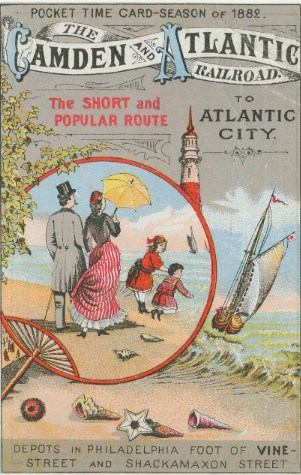
Above Image: 1882 Railroad Schedule Pamphlet Showing Atlantic City Beach Without Dunes.
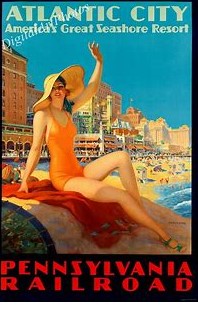
Above Image: 1945 Railroad Poster Showing Atlantic City Beach Without Dunes.
So after that, every single resort that was built by the ocean, the first thing they did was level the dunes. And you could look at the photographs of Atlantic City from 1870, 1890, 1910, 1920, 1950, 1980: flat sand, everybody enjoying themselves, bulkheads protecting the hotels and the streets and the restaurants from flooding. It worked for 100 years.
So you didn’t have a problem until, number one, you had these—this woke culture started to come about in the 1980s and 1990s that whatever made America great, whether it’s the family, whether it’s the automobile, whatever—whether it’s schools, religion, anything—they had to destroy everything. And one of the things was to punish rich people for enjoying an oceanfront house where they could look out the window and see the ocean.
As someone who grew up here, we all know that sand moves. And normally the sand moves down, towards the south, because northeast storms, by their very nature—the strong northeast winds push the water and push the sand down. I don’t know about Wildwood, but I do know Atlantic City. I do know when they built that long jetty in Brigantine right across from the inlet, that is when the uptown Atlantic City began to lose its beach at that point. And the sand moves. I mean, sand moves; it’s been moving for a billion years. The lighthouse of Atlantic City—that was right by the beach when it was first built, and now it’s like two or three blocks away from the beach. So yeah, this is a barrier island made of sand, and sand moves around.
Just like my dad swore that that wooden rifle he held in his hands kept the Krauts away from the St. Charles Hotel in World War II. Yeah. And one thing I’ve noticed over the years: ordinary people using common sense—whether they’re at a Liberty and Prosperity breakfast—they’re more likely to get it right, to get to the truth, and come up with common-sense facts and solutions than so-called experts. Because the so-called experts are not interested in the truth; they’re interested in getting their funding for next year, pleasing the politician who hired them. And if you just know people who lived their entire lives by the shore, they know that the sand dunes are absolutely ridiculous, they’re insane. But the people who are making lots of money from it, they’ll come up with study after study.