
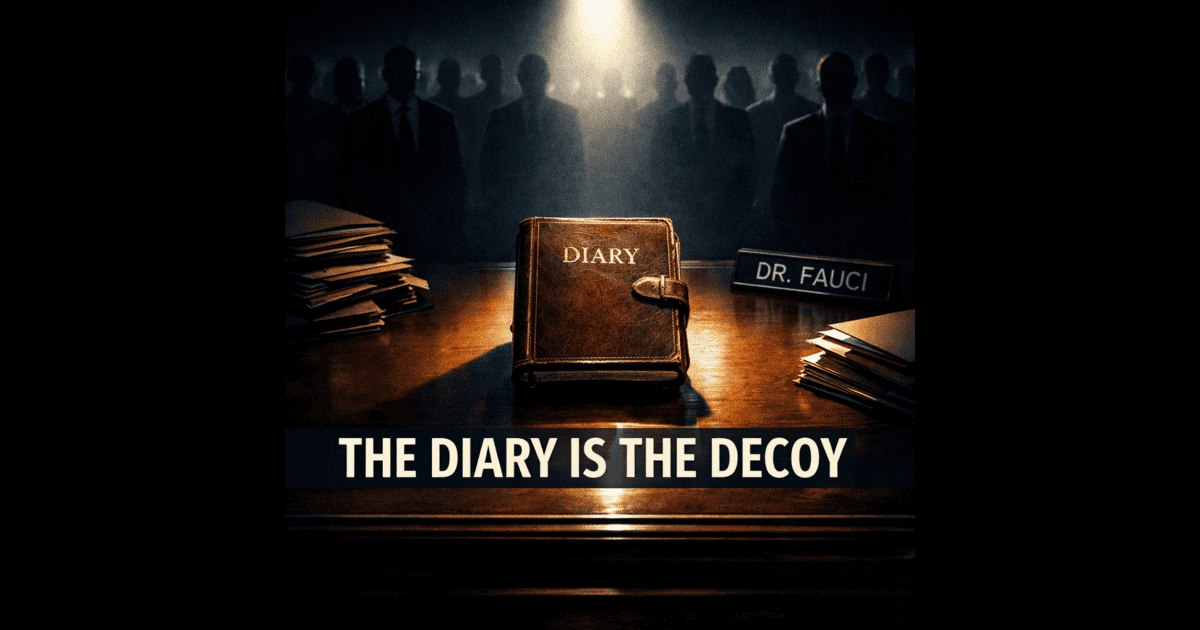
Why the “Diary” Is the Distraction
The Fauci Made-for-TV Show: Why the “Diary” Is the Distraction
There is no Fauci Diary (that we know of). They did not find a leather-bound journal that Fauci kept under his mattress, where each night he wrote, “Dear Diary, today I destroyed the economy of the free world…” That is not what this is. And the word “diary” — warm, intimate, confessional, something a child reads under the covers with a flashlight — is doing more political work than any document released so far.
What Senator Rand Paul dropped on the internet on July 27, 2026 is a 1,141-page tranche of near-daily professional notes Fauci kept between December 2019 and December 2022 — the span of his tenure as head of the National Institute of Allergy and Infectious Diseases (NIAID) during the lockdowns. Combined with a 465-page prequel of records and email exchanges from 2001 to 2015, it is a sprawling document dump timed with surgical precision — two days before Fauci was subpoenaed to appear before Paul’s Senate Homeland Security and Governmental Affairs Committee on July 29.
The result? Fauci invoked the Fifth Amendment more than 100 times. Rand Paul got his clips. The base got its catharsis. And the actual machinery of the lockdown response — all fifty-odd names in those same pages — remains completely undisturbed.
Let us work through what is actually happening here.
Section One: How the “Diary” Appeared Out of Thin Air
The documents did not appear out of thin air — but they were made to feel like they did. That is the first trick.
Health Secretary Robert F. Kennedy Jr. publicly stated that his team located the notes across eleven separate government servers, and that it took his office roughly eight months to piece them together. Once compiled, HHS handed the files directly to senators Rand Paul and Ron Johnson, both of whom have spent years investigating the origins of the lockdowns.
The framing of “discovery” — of secrets finally wrenched from the vaults of the administrative state — is politically essential. It gives everyone involved a dramatic arc: the brave investigators, the hidden truth, the cornered villain. But consider the timeline. Kennedy took office in early 2025. He had both the authority and the access from day one. The eight-month “dig” did not begin because the documents were hard to find. It began when the political conditions were ripe to use them.
Paul posted the documents, took them down Monday evening, then reposted them Tuesday morning with redactions — suggesting the release was still being managed in real time.
| Source | Key Fact |
|---|---|
| Epoch Times, July 28, 2026 | RFK Jr. says notes found across 11 government servers, took 8 months to compile |
| Reuters, July 29, 2026 | Paul published a 1,141-page tranche of Fauci’s notes and subpoenaed him to appear before the committee |
| NPR, July 27, 2026 | Paul posted, pulled, and reposted documents with redactions within 48 hours of release |
Section Two: What the “Diary” Actually Is — And What the Word Hides
The word “diary” conjures a private thing — something hidden in a drawer, something a child guards under the covers with a flashlight. That image is exactly why it was chosen. And it is doing something very specific and very misleading.
What the 1,141 pages actually contain are near-daily professional notes Fauci kept during the lockdowns: his reactions to media coverage, interactions with the White House, early conversations about the virus’s possible origins, scientists’ concerns about the furin cleavage site, and notes about tensions over gain-of-function funding tied to EcoHealth Alliance and the Wuhan Institute of Virology.
These notes were stored on government servers — which means they were always, legally, government property. They were always subject to FOIA requests and internal audit. They were always the public’s business. The “discovery” phase was not about breaking into a vault; it was about administrative staff choosing to finally aggregate files that had been sitting in plain sight within the bureaucracy. Anyone who used taxpayer-funded systems to steer what the government does surrendered any claim to privacy the moment they hit send.
But here is what the word “diary” specifically prevents you from asking: Who else was reading this? Who was on the CC line? Who was commenting, acting, responding?
A diary is a monologue. These notes are a switchboard. Every entry involves a cast of dozens — other bureaucrats, task force members, White House liaisons, media contacts, academic partners, tech platform coordinators. By calling it a “diary,” the architects of this narrative trick you into seeing a single author confessing in private — rather than a node in a network that ran the entire lockdown apparatus. The word “diary” is not just misleading. It is a containment device. It stops you from demanding the other fifty names.
If Paul had released “Director Records and Work Notes of Dr. Anthony Fauci, 2019–2022,” the story would have been Page A14. “Fauci’s Diary” was front page everywhere — and no one asked who else was in the room.
| Source | Key Fact |
|---|---|
| factually.co (record retention analysis) | Notes on official government systems are legally agency records — government property from the moment they were created |
| factually.co, July 2026 | Notes are near-daily professional records covering origins, White House friction, media, and gain-of-function funding |
| CBS News, July 28, 2026 | Paul framed entries as revealing “private views at odds with public statements” — the “diary” frame enables exactly that spin |
Section Three: The Evidence That Was Always There — Open States Did Not Do Worse
Before we discuss the theater of the hearings, we should name the obvious: the case against the lockdowns does not need a diary. It was already in the data — for anyone willing to look at it.
Florida reopened businesses well ahead of most states. DeSantis ended the lockdowns early and refused to extend school closures. The prediction from the lockdown advocates was catastrophe. What happened instead? In a 2022 study published through the National Bureau of Economic Research, the Committee to Unleash Prosperity graded every state on three measures — health outcomes, economic performance, and impact on education. The best performers were Utah, Vermont, Nebraska, and Florida. The worst were New Jersey, New York, California, and Illinois — the states that locked down hardest and longest.
A peer-reviewed study published in BMC Public Health found something equally blunt: there was no statistically significant relationship between excess mortality and how open or closed a state was. Lockdowns were, by the most important single metric — how many people actually died — not significantly beneficial. They were, however, catastrophic for employment and children’s education.
Then there is Sweden. Sweden refused a mandatory lockdown throughout the crisis. The prediction from figures including Fauci was disaster. What actually happened? Over the full three lockdown years (2020–2022), Sweden’s excess-death rate was 4.4% above its pre-crisis baseline. The European average was 11.1%. Sweden had the lowest excess-mortality rate of any country in Europe — less than half the continental average, and less than half of America’s. As the Cato Institute put it: “It was not Sweden that engaged in a reckless, unprecedented experiment, but the rest of the world.”
The Great Barrington Declaration, authored in October 2020 by epidemiologists from Harvard (Dr. Martin Kulldorff), Stanford (Dr. Jay Bhattacharya), and Oxford (Dr. Sunetra Gupta), argued for exactly this approach: focused protection of the vulnerable, not broad societal shutdown. It was signed by more than 54,000 scientists and physicians. What happened? NIH Director Francis Collins wrote to Fauci on October 8, 2020 and called for “a quick and devastating published takedown” of the Declaration, calling its Harvard, Stanford, and Oxford authors “fringe epidemiologists.” That email was not in any diary. It was obtained years ago through a routine FOIA request. The information was always there.
| Source | Key Fact |
|---|---|
| Committee to Unleash Prosperity / NBER, April 2022 | Florida: top-four grade. NY, NJ, CA, IL: worst performers. Open states outperformed locked states on health, economy, and education |
| Cato Institute, August 2023 | Sweden: lowest excess mortality in all of Europe (4.4% vs. 11.1% average) with no mandatory lockdown — less than half of America’s rate |
| The Blaze (FOIA emails), December 2021 | Collins to Fauci, Oct. 8, 2020: “There needs to be a quick and devastating published takedown” of the Great Barrington Declaration — obtained by routine FOIA years before any “diary” release |
Section Four: The Fifty Others They Will Never Call
Here is the question no one on the committee is asking: If Fauci is guilty, who was on the CC line?
Every entry in those 1,141 pages involves other people. The lockdown response was not a solo performance. The cast includes:
Dr. Deborah Birx — the Coronavirus Response Coordinator who designed the state-level implementation of the mandates Fauci’s guidance shaped. Robert Redfield — the CDC Director whose agency was the clearinghouse for the data used to justify the federal response. Hugh Auchincloss — Fauci’s Principal Deputy Director at NIAID, whose inbox would show which decisions were made before they ever reached Fauci’s notes. Dr. Francis Collins — whose “devastating takedown” email proves he was not a bystander but an active suppressor of scientific dissent.
Beyond the inner circle: the mid-level communications staff at CDC and NIH whose job was to coordinate with social media platforms to flag “misinformation.” The academic journal editors whose gatekeeping kept competing studies out of print. The task force media liaisons who fed daily talking points to major newsrooms.
These are not hypothetical figures. They are real people with government email addresses, documented meeting attendance, and paper trails that exist on the same eleven servers from which the “diary” was extracted. Not one of them has been subpoenaed. The committee’s focus has remained, with discipline, on one man.
The reason is not complicated. Calling the other fifty would transform this from a morality play — “Fauci was a rogue actor” — into an institutional indictment. It would force the committee to acknowledge that the lockdown response was not an individual failure but a coordinated, multi-agency enterprise involving hundreds of career officials across both the Trump and Biden administrations. That is a story that implicates everyone, including many Republicans who governed states, voted on emergency funding, and stayed quiet when political courage was actually on the line.
The “diary” frame is a containment field. It keeps the energy of public outrage focused on one retired bureaucrat while the rest of the machinery continues undisturbed.
| Source | Key Fact |
|---|---|
| Free Republic / FOIA records, December 2021 | Collins email proves Fauci was not alone — NIH Director actively coordinated the suppression of dissenting scientific views |
| Great Barrington Declaration, October 2020 | 54,000+ scientists and physicians signed a statement opposing broad lockdowns — it was a network of officials who suppressed it, not one man |
| NPR, July 29, 2026 | Paul’s committee focused entirely on Fauci’s individual notes — no subpoenas for the dozens of other officials named in the same documents |
Section Five: The Permanent “Victory Is Near” Machine
The deepest problem with the Fauci Made-for-TV Show is not that it is dishonest about the past. It is that it is effective at preventing accountability in the future.
Consider the pattern. The Republican base has been promised, in sequence: the Durham Report, the Hunter Biden laptop hearings, the Twitter Files hearings, the “weaponization of government” hearings, the previous Fauci testimony in the House, and now the diary hearings. Each time, the framing is identical: “Now we have them. This is the bombshell. This time, justice.” Each time, the political energy peaks during the televised spectacle, disperses when nothing structurally changes, and waits for the next cycle.
This is not a bug. It is the design.
The hearing is not the precursor to justice. The hearing is the product being delivered. It is the pressure-release valve on the boiler of public anger. A grand jury produces indictments. A hearing produces clips. A hearing with a Fifth Amendment invocation produces viral clips.
If the goal were structural accountability — if the Republicans genuinely believed the lockdown response was a coordinated fraud — the natural response would be legislation: defunding the communications coordination infrastructure at HHS, restricting agency authority to coordinate with private platforms on speech suppression, or mandating independent audits of gain-of-function research grants. None of that is on the agenda. The agenda is Fauci’s notes.
Meanwhile, the civil servants who drafted the guidelines, managed the server systems, and wrote the talking points that went to CNN are still at their desks. The public-private partnership between government agencies and tech platforms that coordinated content moderation is still operational. The academic journals that suppressed competing research still control the peer-review apparatus.
The hearing will end. The committee will declare a kind of victory. Fauci — eighty-five years old and retired — will fade from the news cycle. And in six months, there will be another bombshell. Another diary. Another villain with a name the base already knows.
| Source | Key Fact |
|---|---|
| CNN, July 28–29, 2026 | Fauci took the Fifth more than 100 times — maximum political theater, zero legal outcome |
| Reuters, July 29, 2026 | Paul claimed Fauci “was not allowed” to plead the Fifth — a statement with no legal basis, designed purely for cameras |
| NPR, July 29, 2026 | Fauci’s lawyers described Paul’s campaign as focused on “imaginary crimes” — the hearing as brand-building, not justice-seeking |
Conclusion: What Real Accountability Looks Like
The Fauci diary hearings are not worthless. The documents are real. Some of what is in them is genuinely revealing. The question of whether the government suppressed legitimate scientific debate about lockdown policy — debate backed by Harvard, Stanford, and Oxford epidemiologists — is a serious question that deserves serious treatment.
But “serious treatment” does not look like a subpoena served to one octogenarian retired official, timed to a document dump that was being reposted with redactions forty-eight hours before showtime.
Serious treatment looks like this: subpoenas for everyone who was on the CC lines of those eleven servers’ worth of records. Independent counsel with actual prosecutorial authority, not a Senate committee whose members are fundraising off the spectacle. Structural legislation that changes what agencies can do — not just who runs them.
When you see a senator grandstanding over a “diary,” ask one question: Who else was in the room?
Until that question is answered under oath by the fifty other people in those notes — the task force coordinators, the communications directors, the journal editors, the platform liaisons — you are watching a controlled burn. They are giving you the villain you already know so you do not notice the system they are leaving entirely untouched.
The open states showed us the answer years ago. Sweden showed us the answer. Fifty-four thousand scientists signed a document showing us the answer. None of it required a “diary.”
The diary is not the smoking gun. The diary is the decoy.
Endnotes
- Rand Paul releases Anthony Fauci’s pandemic-era diary notes. NPR, July 27, 2026. npr.org
- Fauci invokes Fifth Amendment in Rand Paul Senate hearing. NPR, July 29, 2026. npr.org
- Anthony Fauci invokes Fifth Amendment in Rand Paul Senate hearing. NPR, July 29, 2026. npr.org
- Fauci diaries, released by Sen. Rand Paul, touch on COVID origins. CBS News, July 28, 2026. cbsnews.com
- Diary entries, a subpoena and an anticipated clash. CNN, July 28, 2026. cnn.com
- Fauci invokes Fifth Amendment at Rand Paul-led US Senate hearing. Reuters, July 29, 2026. reuters.com
- RFK Jr. Says HHS Found Fauci Diaries Across 11 Different Servers. The Epoch Times, July 28, 2026. theepochtimes.com
- Did Robert F. Kennedy Jr. Provide Fauci’s Diaries to Congress? factually.co, July 2026. factually.co
- Government Record-Retention Rules and the Fauci Notes. factually.co. factually.co
- A Final Report Card on the States’ Response to COVID-19. Kerpen et al., Committee to Unleash Prosperity, April 2022. committeetounleashprosperity.com; also published at nber.org
- Sweden Avoided Covid Lockdowns, and Now Reaps the Benefits. Cato Institute, August 2023. cato.org
- Sweden during the Pandemic: Pariah or Paragon? Norberg, J. Cato Institute Policy Analysis No. 959, 2023. cato.org
- FOIA emails: Francis Collins told Anthony Fauci they need a “quick and devastating takedown” of the Great Barrington Declaration. The Blaze, December 2021. theblaze.com
- ‘There needs to be a quick and devastating takedown’: How Fauci and Collins coordinated against the Great Barrington Declaration. Free Republic, December 2021. freerepublic.com
- Great Barrington Declaration (signed by 54,000+ scientists and physicians), October 2020. gbdeclaration.org