This story is from Chapter 14 of my history book 1676 Project: How New Jersey Shaped America. I included it because George Fox, William Penn, Edward Byllynge and John Fenwick carefully studied the experience of other English colonies before they established their “Quaker Commonwealth” in southern New Jersey in 1676.
They recognized and respected the rights of Native Americans living in New Jersey. By doing this, they avoided deadly wars that took placed in Virginia and Massachusetts. They avoided the religious intolerance of Puritans in Massachusetts by recognizing and protecting free speech and religious freedom for all.
The founders of New Jersey also learned from the failure of common ownership of land (what Karl Marx later described as socialism or communism) that had previously brought conflict and starvation to both Plymouth in Massachusetts and Jamestown in Virginia.
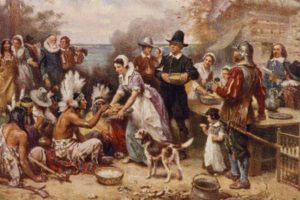
Above Image: “The First Thanksgiving” (1912). Painting by Jean Leon Gerome Ferris. Public Domain.
Storms took the Mayflower to Massachusetts, far north of the land owned by the Virginia Company. However, after exploring the area, its passengers agreed to settle there. Since their contract with the Virginia Company no longer applied, they made a written agreement to run the settlement themselves. It became known as The Mayflower Compact. Those settlers are now known as The Pilgrims.
The Pilgrims found many fields nearby that were already cleared and ready for planting. A Native American named Squanto later approached them. He explained that those fields had belonged to members of his tribe. He said they all had died from a plague a few years before. Squanto befriended the Pilgrims and taught them how to grow native crops like corn, beans, and squash.
However, the Pilgrims failed to grow enough food. Many died of hunger during the first two years. As in Jamestown, there was no private ownership of land. All harvested crops were put into a common storehouse and distributed according to the needs of each family.
During the third year, the Pilgrims divided the land and gave each family its own plot. As in Jamestown, everyone worked much longer and harder for themselves and their families than they did for the community. The Pilgrims then had “bounteous” harvests and gave thanks. They quickly became prosperous and self-sufficient.
William Bradford, their Governor, explained this in his journal.
“No supply (ship) was heard of, neither knew they when they might expecte any. So they begane to thinke how they might raise as much corne as they could, and obtaine a beter crope then they had done, that they might not still thus languish in miserie. At length, after much debate of things, the Governor (with the advise of the cheefest amongest them) gave way that they should set corne every man for his owne perticuler, and in that regard trust to them selves; in all other things to goe on in the generall way as before. And so assigned to every family a parcell of land, according to the proportion of their number for that end, only for present use (but made no devission for inheritance), and ranged all boys & youth under some familie.
“This had very good success; for it made all hands very industrious, so as much more corne was planted then other wise would have bene by any means the Governor or any other could use, and saved him a great deall of trouble, and gave farr better contente. The women now wente willingly into the feild, and tooke their litle-ons with them to set corne, which before would aledg weaknes, and inabilitie; whom to have compelled would have bene thought great tiranie and oppression.
Bradford then reflected on this “experience.” He wrote that it exposed the “vanity” and “conceit” of “godly and sober men” and “ancient” philosophers who advocated community control and ownership of what Communists today call the “means of production.”
“(They claimed) that the taking away of propertie, and bringing in comunitie into a comone wealth, would make them happy and florishing; as if they were wiser then God.
For this comunitie (so farr as it was) was found to breed much confusion & discontent, and retard much imployment that would have been to their benefite and comforte. For the yong-men that were most able and fitte for labour & service did repine (express discontent) that they should spend their time & streingth to worke for other mens wives and children, with out any recompence. The strong, or man of parts, had no more in devission of victails & cloaths, then he that was weake and not able to doe a quarter the other could; this was thought injuestice. The aged and graver men to be ranked and equalised in labours, and victails, cloaths, &c., with the meaner & yonger sorte, thought it some indignite & disrespect unto them. And for mens wives to be commanded to doe servise for other men, as dresing their meate, washing their cloaths, &c., they deemd it a kind of slaverie, neither could many husbands well brooke it. Upon the poynte all being to have alike, and all to doe alike, they thought them selves in the like condition, and one as good as another; and so, if it did not cut of those relations that God hath set amongest men, yet it did at least much diminish and take of the mutuall respects that should be preserved amongst them. And would have bene worse if they had been men of another condition. Let none objecte this is men’s corruption, and nothing to the course it selfe. I answer, seeing all men have this corruption in them, God in his wisdome saw another course fiter for them. . . “
This lesson from this “experience” dominated the culture, economy, and politics of America for the next 350 years.
From Chapter 14 of 1676 Project: How New Jersey Shaped America (2026). Available on Amazon in print, Kindle, and Audible formats. Click below link or image for details: 1676 PROJECT: HOW NEW JERSEY SHAPED AMERICA: Grossman, Seth: 9798994449011: Amazon.com: Books


LibertyAndProsperity.com is a tax-exempt, non-political education organization of roughly 200 citizens who mostly live near Atlantic City, New Jersey. We formed this group in 2003. We volunteer our time and money to maintain this website. We do our best to post accurate information. However, we admit we make mistakes from time to time. If you see any mistakes or inaccurate, misleading, outdated, or incomplete information in this or any of our posts, please let us know. We will do our best to correct the problem as soon as possible. Please email us at info@libertyandprosperity.com or telephone (609) 927-7333.
If you agree with this post, please share it now on Facebook or Twitter by clicking the “share” icons above and below each post. Please copy and paste a short paragraph as a “teaser” when you re-post.
Also, because Facebook, YouTube and other social media often falsely claim our posts violate their “community standards”, they greatly restrict, “throttle back” or “shadow ban” our posts. Please help us overcome that by sharing our posts wherever you can, as often as you can. Please copy and paste the URL link above or from the Twitter share button to the “comments” section of your favorite sites like Patch.com or PressofAtlanticCity.com. Please also email it to your friends. Open and use an alternate social media site like Gab.com.
Finally, please subscribe to our weekly email updates. Enter your email address, name, city and state in the spaces near the top of our home page at Homepage – Liberty and Prosperity. Then click the red “subscribe” button. Or contact us at info@libertyandprosperity.com, (609) 927-7333, or the below address. Thanks.
Seth Grossman, Executive Director
LibertyAndProsperity.com
453 Shore Road
Somers Point, NJ 08244